Complete duct line: how to set up and how much it produces
Short answer: TDC duct production can be set up with separate machines, one for each step, or with a complete duct production line that goes from the steel coil to the folded duct. On Refriweb’s FD5C12, a 1.00 × 0.50 m duct comes out in about a minute and a half, with only the corners and the Pittsburgh closing left to do. Compared with the traditional process, it saves 5 people in production.
What a TDC duct is
A TDC duct is a rectangular air-conditioning and ventilation (HVAC) duct whose connecting flange is formed from the duct sheet itself, at both ends of the section. That is why there is no need to make and attach angle-iron flanges. During installation, corner pieces are fitted into the corners of the flange and the sections are joined with bolts at the corners and clips along the flange.
The longitudinal seam of the duct is usually the Pittsburgh lock, explained in the article Pittsburgh lock on ducts: press brake or Former machine?
The steps of a TDC duct
From start to finish, a TDC duct goes through these steps:
- Cutting: the sheet is cut to the size of the flat duct (the blank).
- Notching: the blank is notched at the ends and at the bend lines, so that the flange and the Pittsburgh lock do not overlap when the duct is folded.
- Pittsburgh: the edges get the Pittsburgh lock, male on one side and female on the other.
- Flange: both ends get the TDC flange.
- Folding: the duct is folded at the corners.
- Corners: the corner pieces are inserted and crimped into the corners of the flange.
- Closing: the Pittsburgh lock is closed.
In traditional production, each step is done on a different machine, by different people. On the complete duct line, the first five steps happen in sequence, without the sheet leaving the machine.
With separate machines
In the traditional process, the sheet is cut on a guillotine shear and goes through one machine for each step: the TDC flange roll former, the Former machine for the Pittsburgh lock and the TDC bending machine to fold the duct. Between one machine and the next, parts are carried, stacked and checked.
To keep up with the output of a complete duct line this way, it takes 8 people: 4 on the bending machine, 2 on the TDC machine and 2 on the Pittsburgh machine. And the duct dimensions depend on how carefully each operator marks and folds.
With the complete duct line
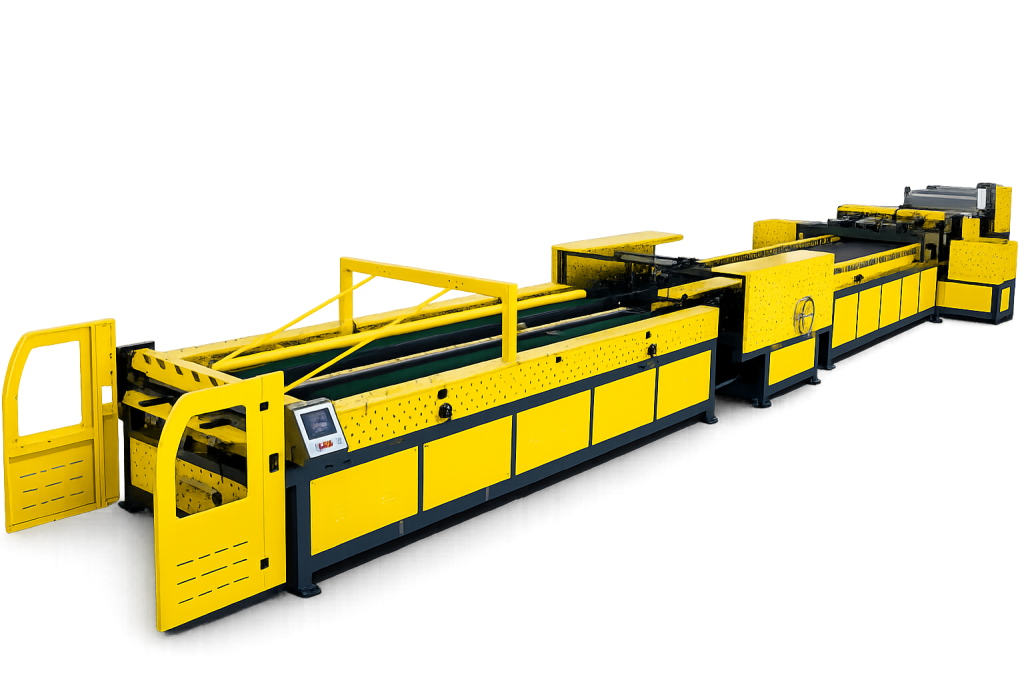
On the FD5C12 complete duct production line, the sheet comes off the coil and goes through the first five steps without being taken off the machine: blank cutting, notching, male and female Pittsburgh, TDC/F flange on both sides and duct folding.
It is controlled by a PLC with an HMI: the operator types the duct size on the panel and the machine does the rest. The duct comes out almost finished. Only two steps are left, done off the machine: fitting the corners, with the IC1C12 corner inserting machine, and closing the Pittsburgh lock, with the FP1C12 Pittsburgh seam closer.
How much the complete duct line produces
On the FD5C12, a 1.00 × 0.50 m duct comes out in about a minute and a half, already folded, with the TDC/F flange and the Pittsburgh lock. At a continuous pace, that is about 40 ducts of this size per hour.
Three points help explain this output:
- Thickness does not change the time. The same duct takes the same time with 0.5 mm or 1.25 mm sheet. In kilograms, output grows with thickness: at 1.25 mm, 2.5 times more duct weight comes out per hour than at 0.5 mm.
- Notching takes the same time on small and large ducts.
- Scrap is practically zero, because the sheet comes from the coil and is cut to the size of each duct.
How to compare duct lines
Many spec sheets give only the sheet speed, in meters per minute. The FD5C12 reaches 15 m/min, but that number shows how much material goes through the machine, not how many finished ducts come out of it: notching, profiles and folding also take time.
To compare, ask how long a duct of a known size takes from start to finish, and what is still left to do on it when it leaves the machine. That is the figure that shows real output.
How many people run the complete duct line
Compared with the traditional process, the complete duct line saves 5 people. For safety, Refriweb recommends at least 2 operators on the machine, so that no one works on it alone.
When separate machines still make sense
For those starting out or producing small volumes, separate machines require a smaller investment and allow growth in stages. Even alongside the complete duct line they remain useful: the FD5C12 is built for straight duct sections in series, and elbows, reducers and other special fittings are made separately.
What to check before buying
- Output: how many ducts you make per day today, in which sizes, and how many you want to make.
- Thickness: the FD5C12 works from 0.5 to 1.25 mm (#26 to #18).
- Power and space: the FD5C12 has 25 kW of power and weighs 10 t. Check your electrical supply and floor space with Refriweb before ordering.
- Corners and closing: plan the two steps done off the machine. The IC1C12 inserts and crimps the corners, and the FP1C12 closes the Pittsburgh lock at two parts per minute.
- Crew: at least 2 operators on the machine, for safety.
FD5C12 specifications
- Model: FD5C12*1250
- Sheet thickness: 0.5 to 1.25 mm (#26 to #18)
- Sheet speed: up to 15 m/min
- 1.00 × 0.50 m duct: about a minute and a half, with the corners and the closing left to do
- Control: PLC with HMI
- Power: 25 kW
- Weight: 10 t
Frequently asked questions
How long does the complete duct line take to make a duct?
On the FD5C12, a 1.00 × 0.50 m duct comes out in about a minute and a half, already folded, with TDC/F flange and Pittsburgh lock. Only the corners and the closing are left.
How does the operator set the duct size?
On the panel. It is controlled by a PLC with an HMI: the operator types the size and the machine does the rest.
Does sheet thickness change the output?
Not the time per duct: from 0.5 to 1.25 mm, the same duct takes the same time. In kilograms per hour, output increases with thickness.
How many people does the complete duct line need?
At least 2 operators, for safety. Compared with the traditional process, it saves 5 people.
Can TDC ducts be made without a complete duct line?
Yes. With separate machines, such as the TDC flange roll former, the Former machine for the Pittsburgh lock and the TDC bending machine, each step is done at its own station. It is the most common path for those starting out.
Want to know how much the complete duct line would produce in your shop? Message Refriweb on WhatsApp and tell us the duct sizes and sheet thicknesses you use most.