Pittsburgh lock on ducts: press brake or Former machine?
Short answer: if you make rectangular ducts regularly, a Former machine (Pittsburgh lock former) pays off. Each profile takes about 6 seconds, versus about a minute and a half on a press brake, and it comes out the same across the whole production run. The press brake is still useful for one-off and non-standard parts.
What the Pittsburgh lock is
The Pittsburgh lock is the seam that closes the longitudinal corner of a rectangular duct without welding or rivets. It has two parts:
- Pocket (female Pittsburgh), known in Brazil as bolsa, ilharga, ilarga or americana, depending on the region.
- Flange (male Pittsburgh), also known as single hem or 90° L bend.
The flange goes into the pocket and, once hammered over, locks the corner. Because it is strong and easy to assemble, this seam has been the standard in duct fabrication since the late 1940s.
On a press brake
On a press brake, each profile means marking the sheet, positioning it, bending it and checking it. The pocket is the most laborious part, because it takes more than one bend to form the slot the flange goes into. All told, each profile takes about a minute and a half, and the result depends on the operator’s hand: a pocket that is slightly too open or too closed already gets in the way during assembly.
On a Former machine
On a roll former, the sheet goes in flat and comes out with the profile ready, in about 6 seconds. The rollers form the profile gradually, so the dimension is the same on the first and the thousandth part, with no marking or checking part by part.
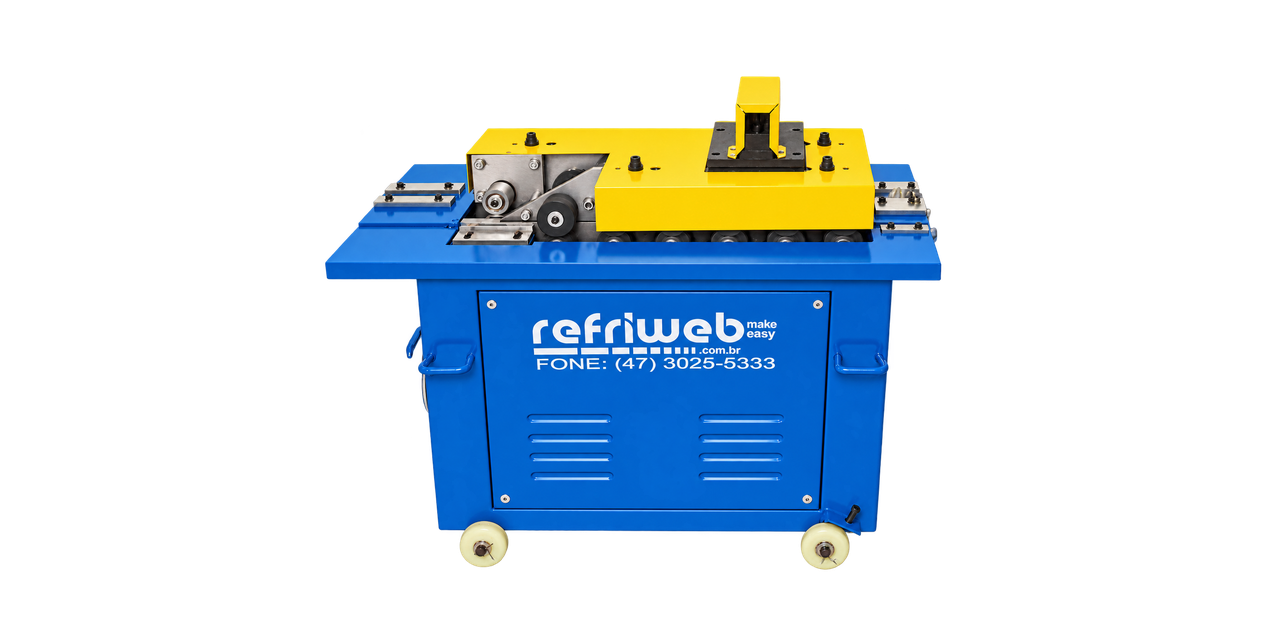
The Refriweb LF6C12 Former makes, on a single machine, the six profiles used in rectangular ducts: the Pittsburgh pocket and flange, the drive cleat, the double hem, the seam and the radius flange.
The time math
Each Pittsburgh closure has two profiles, the pocket and the flange. A duct section can have one to four closures, depending on whether it is made from one, two or four sheets. In the example below, each duct has two closures, which means four profiles:
| Ducts per day | Profiles per day | Press brake | Former | Time saved per month* |
|---|---|---|---|---|
| 10 | 40 | 1 h | 4 min | about 20 h |
| 20 | 80 | 2 h | 8 min | about 41 h |
| 40 | 160 | 4 h | 16 min | about 82 h |
*Based on 22 working days per month, a minute and a half per profile on a press brake and 6 seconds on the Former. It does not include rework from out-of-spec bends, which also goes down.
To work out how quickly the machine pays for itself in your production, multiply the hours saved by your operator’s hourly cost and compare the result with the machine price, shown on the LF6C12 Former page. Besides the time, the same team delivers more parts per shift.
When the press brake still makes sense
The press brake is still useful for one-off bends, non-standard parts and jobs that don’t repeat. In a duct shop the two work side by side: the press brake handles the exceptions and the roll former handles the volume.
What to check before buying a Former
- Sheet thickness: the LF6C12 works with 0.55 to 1.2 mm (#26 to #18) galvanized steel.
- Power: 380 V or 220 V three-phase. If you have no three-phase supply, there is an optional two-phase version with a 220 V two-phase inverter, which has to be requested before the order is closed.
- Space: the machine takes up just over 1 m² of floor space (1.2 × 1.1 × 0.7 m) and weighs 275 kg.
- Profiles: check that the machine makes all the profiles your line uses, not just the Pittsburgh.
- Closing: once formed, the Pittsburgh has to be hammered over. For volume work, the FP1C12 pneumatic Pittsburgh closer handles this step, at two parts per minute.
- Service and parts: Refriweb provides technical support for the LF6C12, in and out of warranty, and keeps original parts in stock.
Frequently asked questions
Are ilharga, bolsa and americana the same thing?
Yes. They are regional Brazilian names for the female half of the Pittsburgh lock, the pocket. The male half is the flange, also called single hem or L bend.
Does the Former machine replace the press brake?
For lock seams, yes. For one-off and non-standard parts, the press brake is still useful.
Can the Former run without three-phase power?
Yes, with the optional two-phase version, which uses a 220 V two-phase inverter. Let us know before ordering so the machine ships already configured.
How long does each profile take on the Former?
About 6 seconds per profile, versus about a minute and a half on a press brake, counting marking, positioning and checking.
Want to run the numbers for your production? Message Refriweb on WhatsApp and tell us how many ducts you make per day and the sheet thickness you use.