Cut & Shear
CNC PU/PIR PANEL CUTTER
PU or PIR panels cut, V-grooved and marked, ready for gluing.
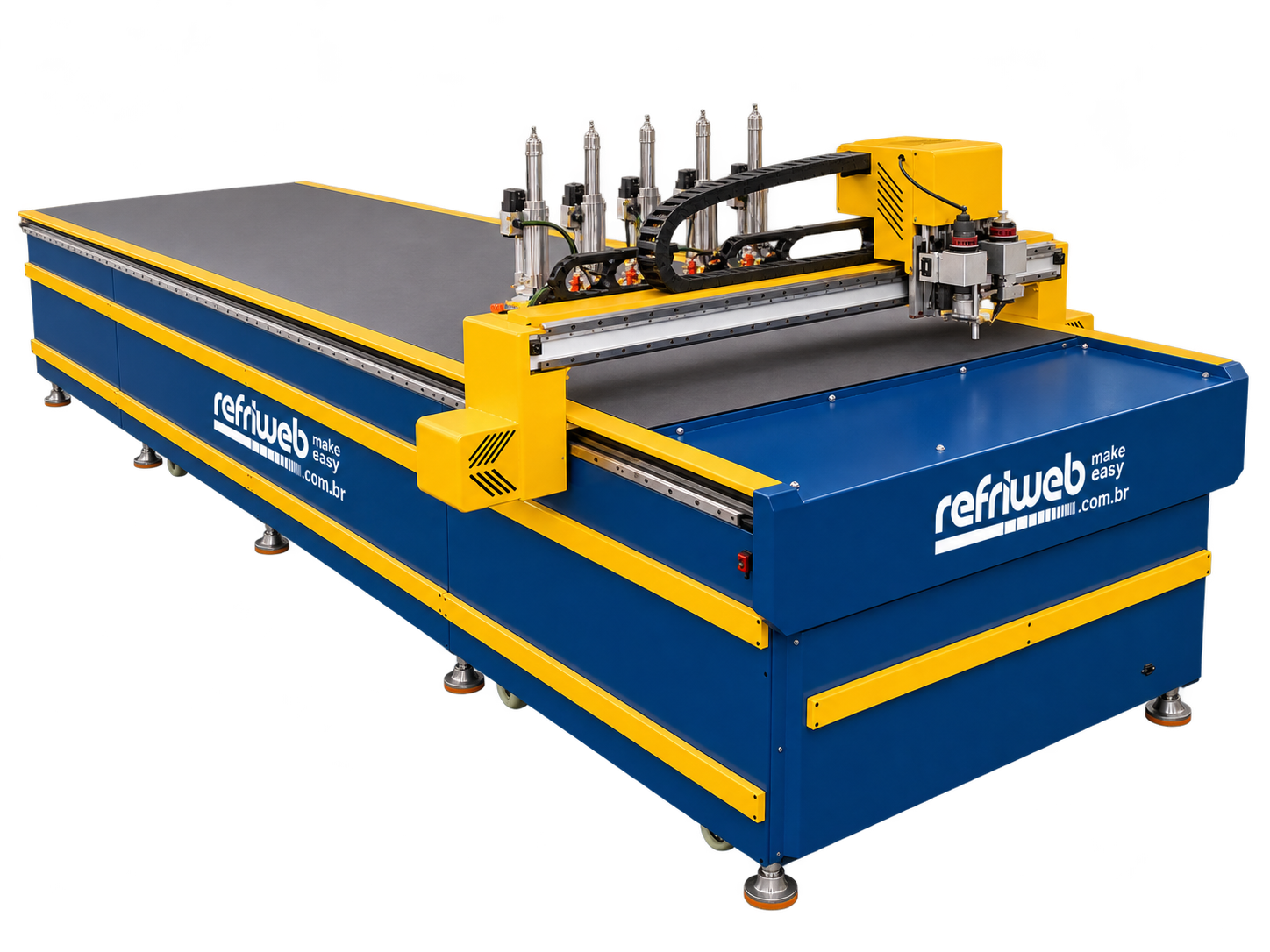
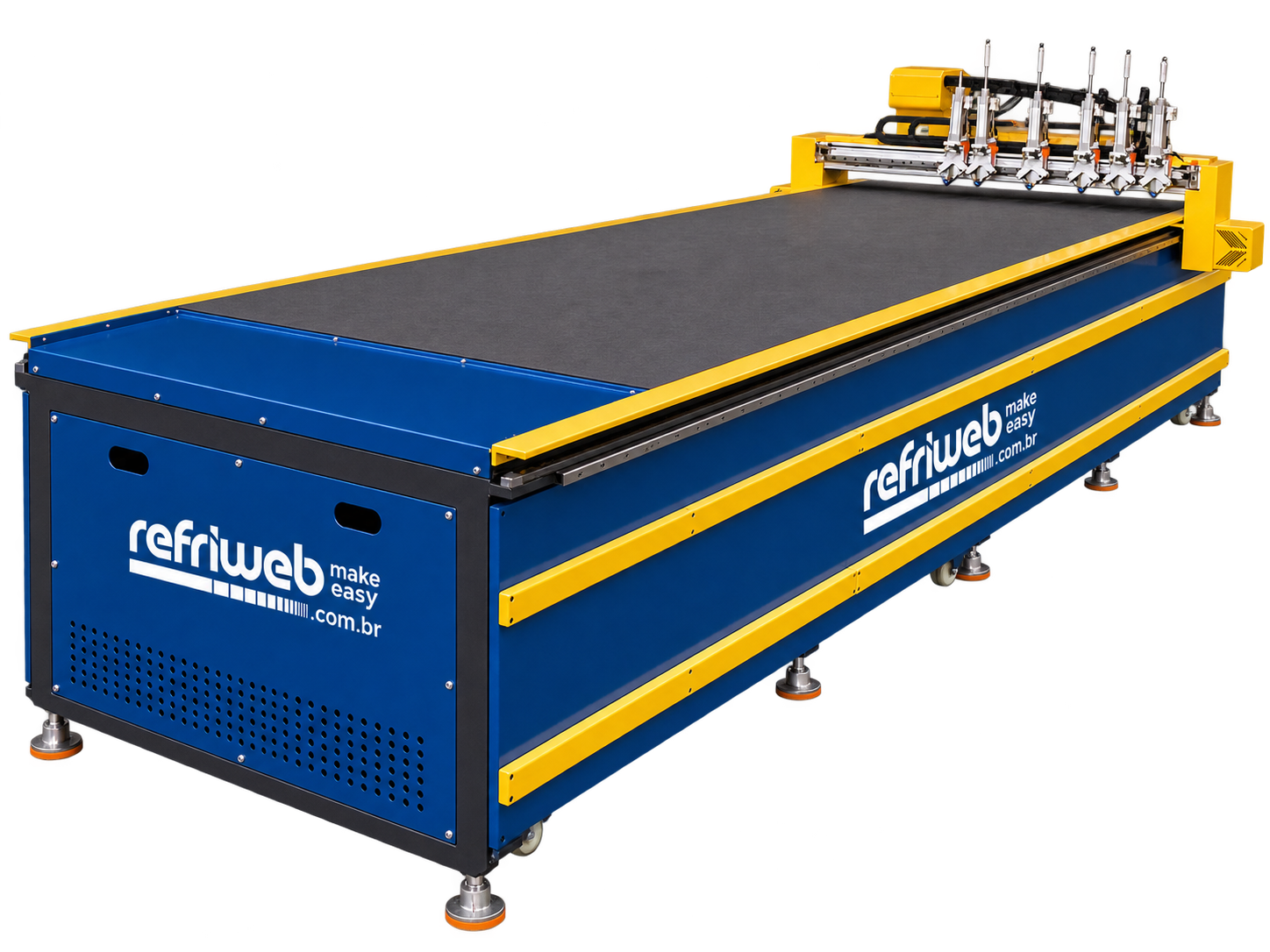
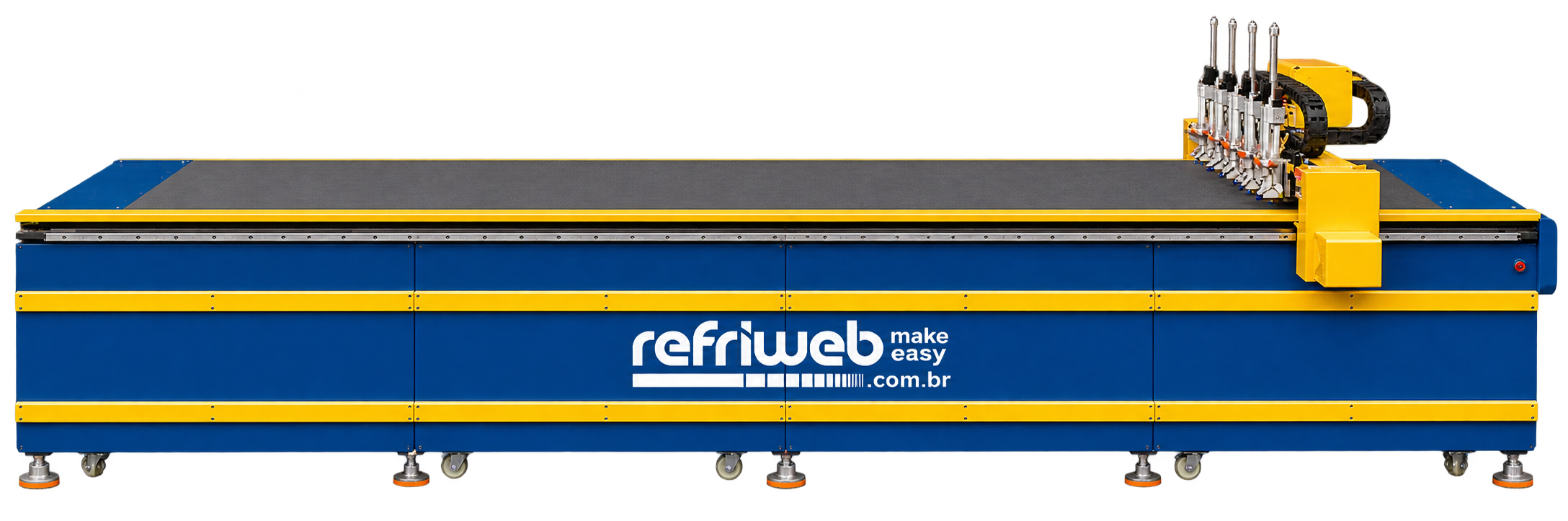
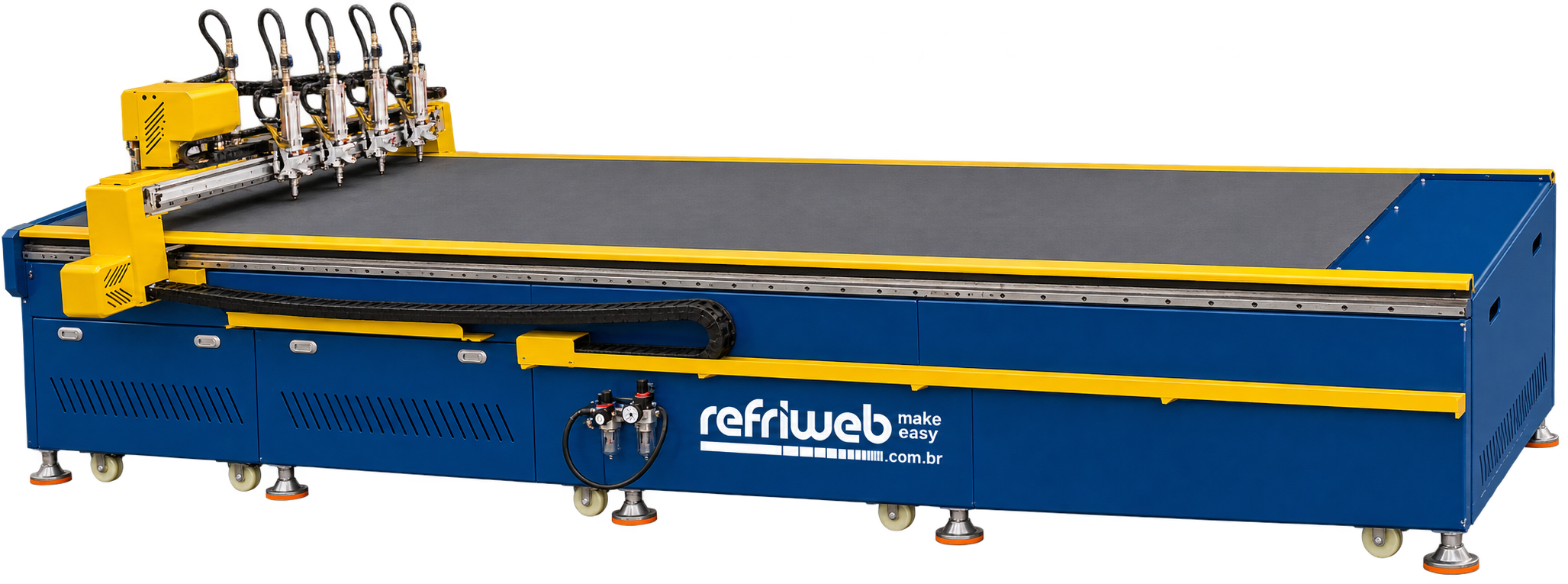
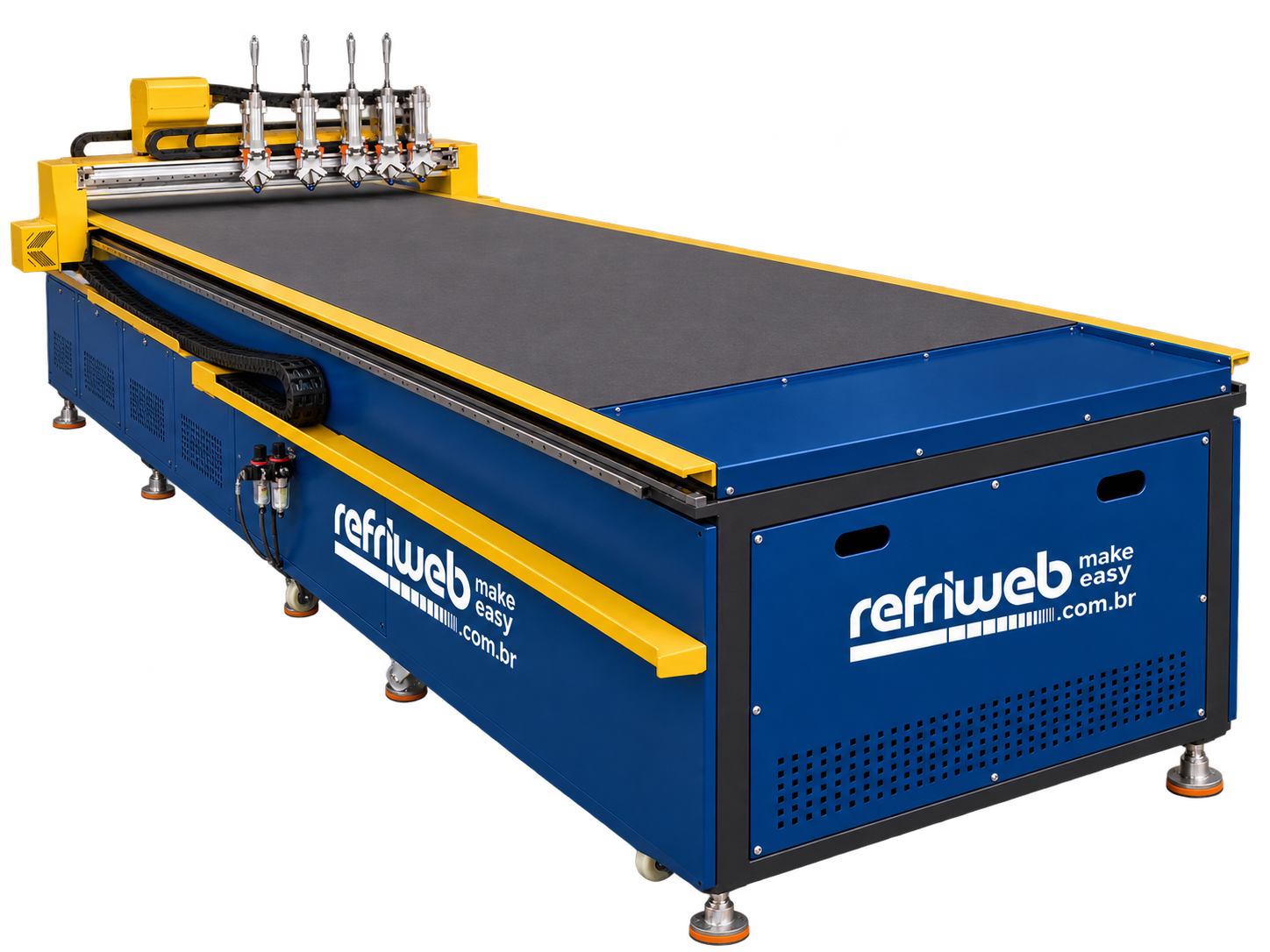
PU or PIR panels cut, V-grooved and marked, ready for gluing.
The CF2C30 × 1240 cuts Brazilian-made polyurethane (PU) and polyisocyanurate (PIR) panels faced with aluminum on both sides, the same panels Brazilian workshops already use to make ducts. The drawing goes from the computer to the machine, the vacuum table holds the panel in place, and the machine marks, V-grooves and cuts out the entire part. One operator does the cutting that currently keeps five people busy with a ruler, pen and knife. The gains show up in four places: payroll, floor space, panels that no longer become scrap, and project delivery times.
One machine, the cutting work of five people
Caixa's SINAPI allows 0.18 metalworker-hours per square meter to cut and fold pre-insulated panel ductwork by hand. Measuring, marking and using the knife alone amount to around 8 m² per person per hour. The CF2C30 × 1240 cuts 40 m² per hour with one operator, including loading, unloading and job changes: the work of five people at the bench.
Made for Brazilian panels
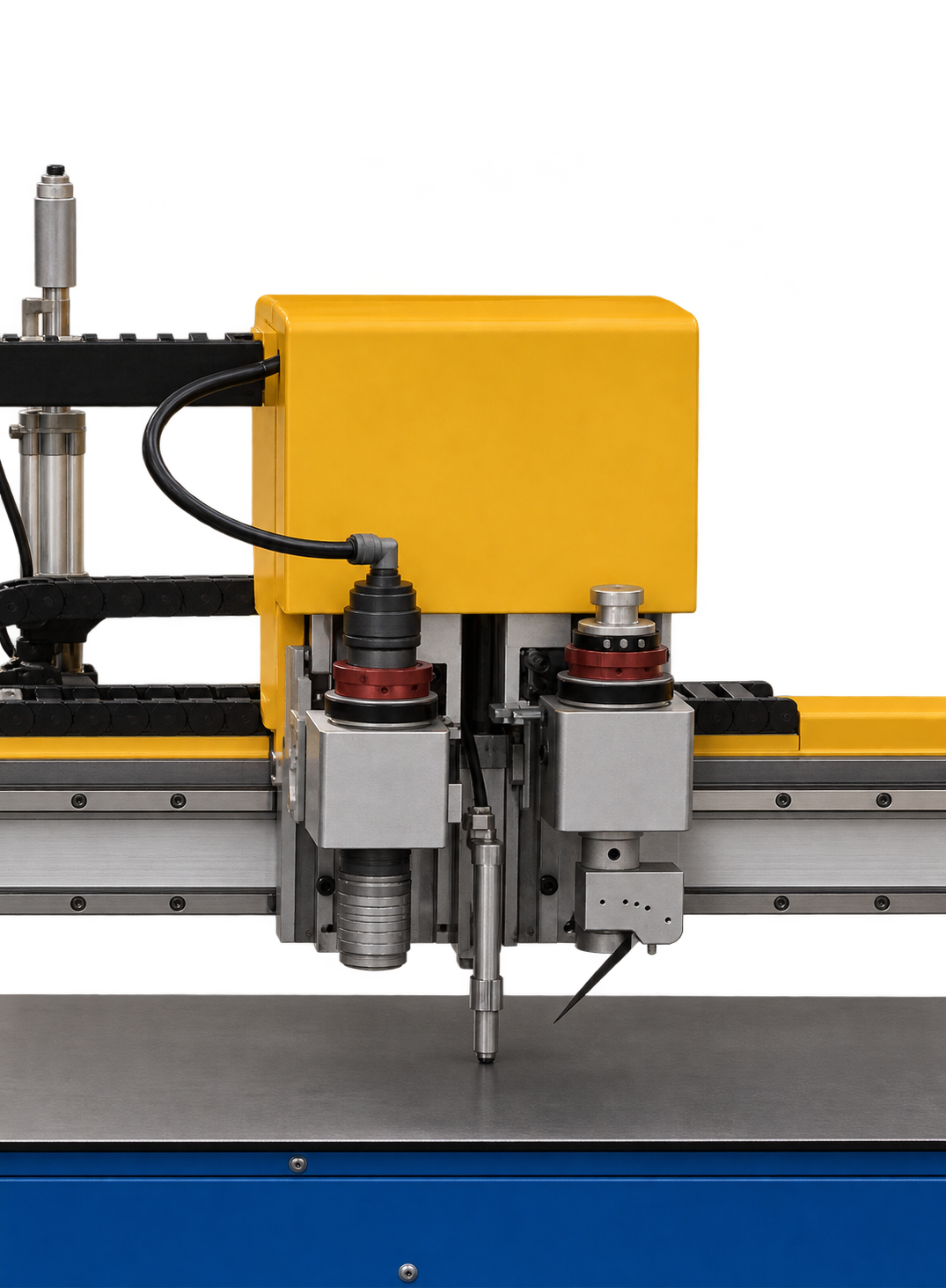
Brazilian PU or PIR panels have rigid foam between two aluminum sheets. The V-knife removes a wedge of foam at the exact angle and stops at the aluminum on the outer face, which becomes the part's hinge. The fold closes without a gap, leaving the joint ready for adhesive and tape.
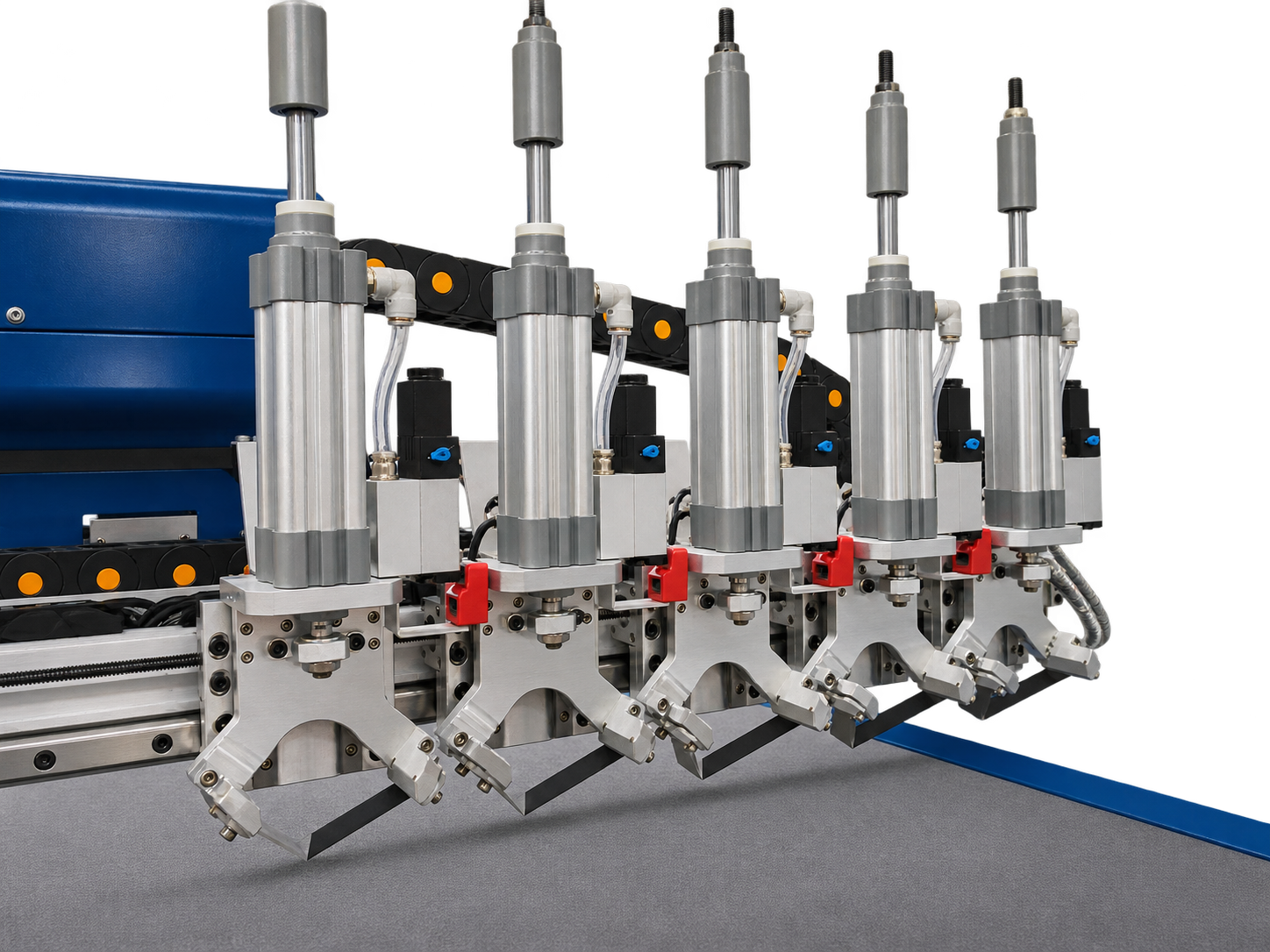
Five V-grooving units
Behind the beam are five pneumatic units for straight V-grooving. Adjusted to the duct dimensions, they lower together and groove all the folds of a straight duct in a single pass along the panel's 4-meter length. The panel leaves the table ready for gluing and closing.
Elbows, transitions and branches without templates
On the front head, the V-knife, adjustable from 0° to 45°, cuts the outline supplied by the drawing: elbow, transition, branch or end cap. A part that requires a template and an experienced professional when made by hand comes out the same from the first to the hundredth time.
Every part has a name
The pen on the front head writes the project, code and assembly side on the part. When it is time to fold and glue, nobody mixes up parts or assembles an elbow the wrong way around.
Less panel in the waste bin
By hand, each part is marked individually, and the leftovers from elbows and transitions become scrap. On the CF2C30 × 1240, the parts are nested in the drawing before cutting, fitting between one another. In the calculation below, waste falls from 10% to 5%, and every percentage point matters: 20 mm PU panel costs around R$ 70 per m² (ORSE, 2026).
Accurate dimensions, closed folds
Servomotors with dual drive along the length, rack-and-pinion drives and linear guides take the knife to the same point on every part. With the groove at the correct angle and depth, the fold closes at 90° and the duct assembles square, without shims.
Faster assembly in the workshop and on site
A part cut to size folds, glues and closes on the bench without adjustment or touch-ups. On site, one section fits into the next in line with the design: no trimming, no shims and no extra tape to cover gaps. The installer lifts the duct into place and moves on to the next section, and this gain is not even included in the calculation below.
The panel stays firmly on the table
The vacuum table has an aluminum honeycomb surface with felt, four zones and a 7.5 kW pump. The lightweight panel, which slips and warps on a workbench, stays fixed in place from the beginning to the end of the cut.
From the drawing straight to the table
The controller reads DXF, PLT and AI files via USB or the network. The drawing can come from any CAD program or ductwork software, and the part drawn in the office is the part that comes off the table.
Ergonomics
The repetitive work of holding a knife while bent over the panel is removed from the bench, the type of workstation that NR-17 requires to be adapted to the worker. The operator places the panel on the table and removes the finished parts.
More projects with the same team
With the month's cutting completed in just a few days of machine time, folding and gluing keep pace with the project. The workshop takes on larger jobs without hiring and without waiting for a new cutter to learn the work.
How much it gives back each month
An example of a medium-sized workshop, with around five people working on panels, producing 2,500 m² of ductwork per month and working 40 hours per week, with a metalworker costing R$ 18.80 per hour including employment costs (average CAGED wage). The figures are deliberately conservative:
Labor: cutting that currently takes 315 person-hours per month fits into 63 machine hours. That is around 250 fewer hours, R$ 4,700.
Panel: waste falls from 10% to 5%, meaning 146 m² less per month at R$ 70 per m², R$ 10,200. This figure assumes that the parts are nested in the drawing before cutting.
Total: around R$ 15,000 per month.
At 4,000 m² per month, the gain approaches R$ 24,000 and payback falls to 10 months. Abroad, the difference is even greater: in the United States, a manufacturer of machines for phenolic panels, in the same family as PU and PIR, advertises duct production up to 20 times faster than by hand.
Return on investment
| Equivalent number of people cutting by hand | 5 people |
|---|---|
| Cutting hours freed up | 253 hours per month |
| Cutting labor | R$ 4,747 per month |
| Reduction in panel purchases | 146 m² per month |
| Panel savings | R$ 10,234 per month |
| Total gain | R$ 14,981 per month |
| RETURN ON INVESTMENT IN | 15 months |
Estimate for a workshop producing 2,500 m² of panel ductwork per month and working 40 hours per week, based on the investment stated in the proposal. Manual productivity from SINAPI, average wage from CAGED and panel price from ORSE, 2026; panel savings assume that the parts are nested in the drawing before cutting. Recalculate using your factory's own figures.
Notes: the calculation does not include cutter training, cover for holidays and absences, uniforms and PPE, transport allowance, meals, medical examinations, rework caused by cutting errors, or faster assembly and installation. Including these brings payback forward.
References: Caixa, SINAPI, Technical Handbook for Air Conditioning Ductwork, composition 98370 (AF_03/2024); ORSE, composition 13514 (May 2026); Portal Salário/CAGED 2026 (metalworker, CBO 7244-40); Contabilidade Zen 2026 (employment costs); NR-17, Ergonomics; GoMech, KD1000 machine for phenolic panels (up to 20 times faster than by hand); P3, P3ductal 2018 catalog (automatic straight cutting: a 4-meter duct ready for gluing in one pass).
Stop paying five people to cut panels by hand with a knife. Put the drawing to work.
Remote guidance for installing, maintaining and operating the equipment is included.
This proposal includes one day of training at our premises.
Especificações técnicas
- Model: CF2C30 × 1240
- Cutting area: 1,200 × 4,000 mm
- Panel thickness: Up to 50 mm
- Power / voltage: 11 kW (380 V, three-phase + neutral + earth)
- NCM code: 8465.99.00
- Weight: 1,400 kg
- Dimensions (H × W × D): 1.8 × 2.4 × 4.9 m
- Availability: Upon request
- Accessories: 5 straight V-grooving units, marking pen and vacuum table
- Requirements: Compressed air from 8 to 10 bar
Veja também

Bending
Hydraulic press brake
Hydraulic press brakes from 30 to 400 t, in versions supplied on request.
Square Duct
Duct manufacturing line
Uncoil, level, shear and bend ducts TDC 35/25, C cleat and S lock
- "L" Duct and TDC35/25
- Profile or C cleat and S lock
- Flat Duct and Grooved Duct